
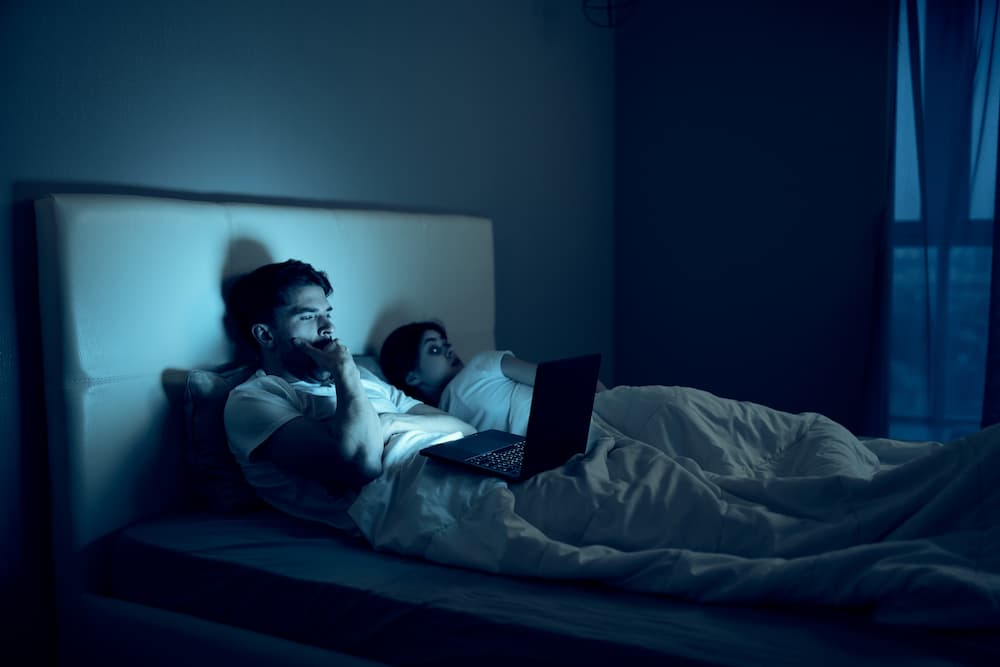
For most of human history, night meant darkness. Not ambiance, not a soft glow, not a phone on a bedside table—actual darkness. That absence of light wasn’t a lifestyle choice or a wellness preference; it was a biological constant. In just over a century, we’ve replaced it with LEDs, streetlamps, screens, and night lights, and we’ve done so without seriously asking what this rupture might cost the human body.
A large, long-running study out of the UK has begun to supply an answer. Researchers followed nearly 85,000 adults for close to eight years, using wrist-worn sensors to capture real-world light exposure across more than 13 million hours of daily life. This wasn’t a survey about habits or self-reported sleep quality. It was objective measurement, minute by minute, night after night. When the data were compared against new diagnoses of type two diabetes, the pattern was difficult to ignore.

Individuals exposed to more light while sleeping had a substantially higher risk of developing diabetes than those who experienced the darkest nights. The increase wasn’t marginal. Moderate nighttime light exposure was associated with roughly a 30% higher risk. Brighter exposure pushed that number past 40%. The highest exposure group saw their risk climb beyond 50%. These associations held even after adjusting for age, physical activity, diet quality, body weight, smoking, and socioeconomic factors. The signal that remained was light itself.
What makes these findings unsettling is not simply their scale, but their implications. We tend to frame metabolic disease as a moral failure or a behavioral deficit—too much sugar, too little movement, insufficient discipline. This research suggests something more structural and more insidious: that the environment we sleep in may be actively working against the body’s capacity to regulate itself.
Light at night interferes with the circadian rhythm, the internal timing system that governs not only sleep and wakefulness, but hormone release, immune function, and glucose metabolism. When the body expects darkness and receives illumination instead, signals become scrambled. Melatonin production is suppressed. Cortisol rhythms flatten. Insulin sensitivity declines. Over time, blood sugar regulation degrades. This is not a dramatic collapse, but a quiet erosion, one night at a time.

There is a deeper irony here. Artificial light is often marketed as safety, convenience, and progress. A night light for reassurance. A phone within reach for connection. A glowing cityscape as evidence of vitality. Yet the body interprets this glow not as comfort, but as confusion. It is being told, biologically, to stay alert when it was designed to rest, repair, and recalibrate.
The urgency of this research lies in its reversibility. Unlike genetic predispositions or irreversible damage, nighttime light exposure is modifiable. The study’s authors noted that reducing light during sleep corresponded with measurable reductions in risk. Darkness, in other words, still works. Simple changes—dimming lights before bed, eliminating glowing screens from the bedroom, using blackout curtains, avoiding blue-heavy bulbs at night—are not cosmetic adjustments. They are interventions that restore the conditions under which the body knows how to heal.
This reframes sleep hygiene from a soft wellness concept into a matter of metabolic stewardship. A dark bedroom becomes less about ambiance and more about alignment. It is a choice to stop fighting the body’s design and start cooperating with it. In a culture that prizes constant visibility and perpetual stimulation, choosing darkness can feel counterintuitive, even irresponsible. The data suggest the opposite.

There is a moral clarity to this finding. When an environmental factor increases disease risk by half, independent of personal behavior, ignoring it becomes a form of negligence. We do not need to wait for more apps, supplements, or optimization strategies. The intervention is ancient, accessible, and free. Turn off the lights. Let the night be night again.
Healing often begins not with addition, but with removal. In this case, removing light restores a rhythm that has guided human physiology since long before electricity. Darkness is not deprivation. It is instruction. And for bodies quietly drifting toward metabolic dysfunction, it may be one of the most merciful corrections available.