
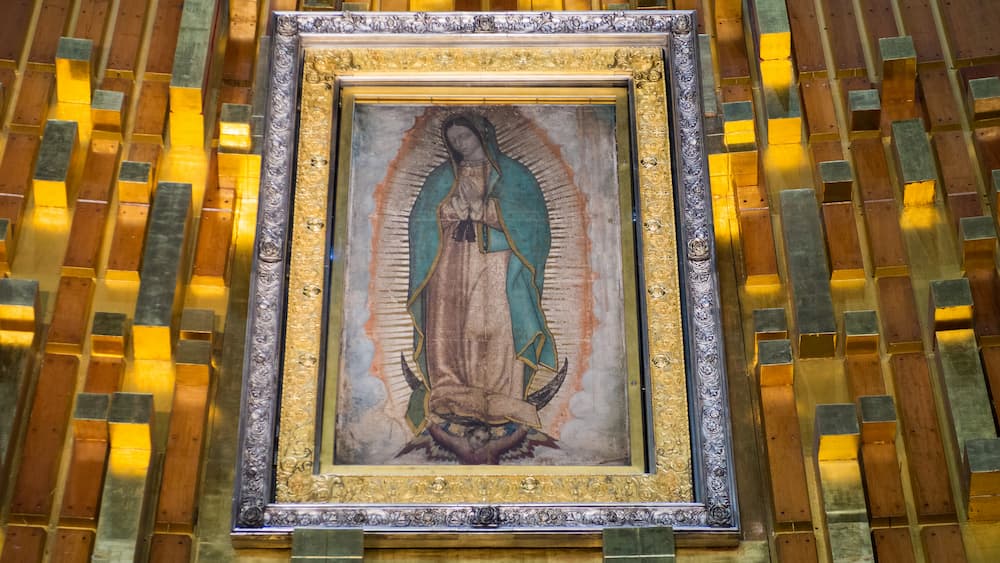
This is written first to those who love her.
To those who grew up with her image on the wall of their childhood home, watched their mothers pray before her candle, and were taught that devotion to her was devotion to God. This is written to those in Mexico, and across the world, for whom December 12th is not an abstract date, but a living tradition woven into family, identity, and history.
My own family being wrapped in this devotion, I understand how questioning it’s authenticity can feel like betraying your mother, your grandmother, your culture, even your people. I understand how Catholicism, especially in Latino communities, does not simply shape belief; it shapes belonging. To walk away or even question its authority can feel like walking alone.
Please understand that this is not written out of hatred, to shame, to mock anyone’s faith or dismiss sincerity. It is written because Jesus loves you too much to let you be comforted by a lie.

The longing behind Marian devotion is not evil. It is human. It is the ache for protection, for tenderness, for a mother who understands suffering. God Himself designed mothers to reflect His care on earth. That instinct [to run toward mercy, to cling to comfort, to seek refuge] is not something to despise. It is something God placed in you.
But what God placed in you has been exploited.
And that exploitation did not begin in Mexico. It did not begin with Juan Diego. It began with an enemy who has always understood that the fastest way to divert worship from God is not through violence, but through substitution. Not by attacking Jesus directly, but by standing just close enough to Him to feel safe.
Jesus never condemned people for being deceived. He condemned those who deceived them.
So if you have prayed to her, trusted her, sought comfort from her, this is not an accusation. It is an invitation. An invitation to see something painful, but freeing.

Because the truth is this: Jesus never sent her, asked for her worship, appointed her as a comforter, nor established her as a mediator. And He would never appear as something that competes with the Holy Spirit, replaces intimacy with the Father, or draws affection away from Himself.
If Jesus could stand before you today, He would not shame you or ridicule your devotion. He would say, with the same mercy He showed everyone who was misled:
“That was not Me.”
He would tell you that the voice you trusted did not come from Heaven. To know the voice of the Father is not optional for the believer. Jesus said plainly, “My sheep hear My voice, and I know them, and they follow Me” (John 10:27).The implication is unavoidable: if a voice is not His, it is not neutral. It is anti-Christ. Scripture does not allow a middle category between the Spirit of Truth and the spirit of error. Anything that speaks with spiritual authority yet does not testify to Christ as Lord, Savior, and sole mediator is, by definition, anti-Christ; not merely incorrect, but opposed.

What the Apparition Is Recorded as Saying
According to the Nican Mopohua, the 17th-century Nahuatl account traditionally associated with the Guadalupe apparition, the figure who appeared to Juan Diego is recorded as saying the following:
“Know and understand well, my youngest son, that I am the ever-perfect ‘holy virgin Mary,’ who has the honor to be the mother of the ‘one true god,’ through whom everything lives, the lord of all things near us and far from us, the master of heaven and earth.”
“I desire that a sacred little house be built for me here, in which I will show him, exalt him, make him manifest, and give him to the people.”
“Here I will hear their weeping and their sorrows, and heal all their sufferings, hardships, and afflictions.”
“Go now to the bishop and tell him all that you have seen and heard, so that he may understand my will.”
When Juan Diego expressed concern for his sick uncle, the figure is recorded as saying:
“Do not let your heart be troubled.
Do not fear that sickness, nor any other sickness or anguish.
Am I not here, I who am your mother?
Are you not under my shadow and protection?
Am I not the source of your joy?
Are you not in the hollow of my mantle, in the crossing of my arms?
Is there anything else you need?”
She also assured him: “Your uncle is already healed. Do not worry about him.”

Why These Claims Cannot Come From God
More troubling still is the theological function assigned to Mary in popular devotion. She is presented as a comforter, a protector, a source of joy, a refuge for the afflicted. Scripture assigns those roles to the Holy Spirit alone. Jesus promised the Comforter. Joy is the fruit of the Spirit. To transfer those attributes to any other figure [regardless of the name used] is not devotion; it is replacement. And the believer who seeks comfort, peace, or joy from Mary has, functionally, declared no need for the Holy Spirit.
No messenger of Heaven asks for a shrine, receives prayers, or draws trust and dependence to itself. To claim authority over comfort, protection, healing, and access to YHWH is to assume what God has reserved for Himself. It is a direct violation of the Gospel, a displacement of Christ as sole mediator, and a denial of the Spirit’s work. By Scripture’s own standard, such claims are not from God and must be rejected, no matter how familiar, comforting, or revered they have become.
The deception succeeds not because people hate God, but because they love comfort. And few comforts are more powerful than the idea of a mother. Across cultures, and especially within Latino families, motherhood is sacred. Mothers are protectors, intercessors, nurturers. That is a beautiful earthly reality.

But the danger begins when that sacred earthly role is elevated into eternity. Scripture is explicit: earthly relationships do not carry over into Heaven. Jesus Himself corrected this assumption, teaching that in the resurrection there is no marriage, no spousal identity, no continuation of familial roles as we know them. To eternalize motherhood is to contradict Christ.
Mary herself understood this. In Luke 1:46–55, she does not exalt her role. She does not present herself as a refuge, a source of joy, or an intercessor. She magnifies the Lord and rejoices in God her Savior. She identifies herself as a servant, a recipient of mercy, a woman wholly dependent on God. Any portrayal of Mary that departs from this posture is already no longer biblical. Mary is honored in Scripture precisely because she points away from herself and toward God.
The idea of an “eternal virgin Mary” collapses under even basic biblical examination. Scripture tells us clearly that Jesus had brothers. Jesus Himself acknowledged them. At the crucifixion, His family was known and present. To insist that Mary remained eternally virgin is not a harmless tradition, it freezes her in a perpetual pre-crucifixion state. It subtly denies the fullness of Christ’s incarnate life, death, and resurrection. It is not an exaltation of Mary; it is a distortion of the Gospel.

This is why Paul’s warning is so severe. “Even if an angel of light should preach another gospel…” Paul is not speculating. He is stating that appearance, tone, and emotional resonance are irrelevant. The test is content and direction. Who is being glorified? Who is being trusted? Who is receiving prayer, affection, and dependence? If worship is redirected, even subtly away from YHWH, the source does not matter. Satan does not care whether he is worshiped directly or through a counterfeit. Worship misdirected is worship received.
The modern world understands this intuitively through technology. Parents now receive phone calls that sound exactly like their children; voices cloned, emotions mimicked, urgency manufactured. Money is sent because the voice feels real. The deception is not detected by sound quality but by discernment. The request does not align with truth. In the same way, spiritual deception is not revealed by how comforting a voice sounds, but by what it asks for.

An Invitation to Worship Without Substitutes
This is not an attack on Mary as a woman or her role in redemptive history. It is a warning against assigning divinity, eternality, or spiritual authority to something that does not exist. There is no eternal Virgin Mary. There is no Mother of God. God has no origin. God has no mother. Jesus, according to His humanity, had a biological mother. According to His divinity, He is eternal, uncreated, and self-existent.
For believers, especially those raised in cultures where maternal devotion runs deep, this warning is painful but necessary. Do not allow your affection for mothers to become an idol that blinds you to truth. Do not let sentiment override Scripture. God does not compete for worship. He commands it. And He does not share His glory.
Anything that asks you to look elsewhere for comfort, joy, protection, or mediation is not from Him. No matter how gentle the voice. No matter how familiar the face. No matter how deeply it tugs at the heart.
Truth has always been singular.
It is Him.
It has always been Him.
There is no one apart from Him.