
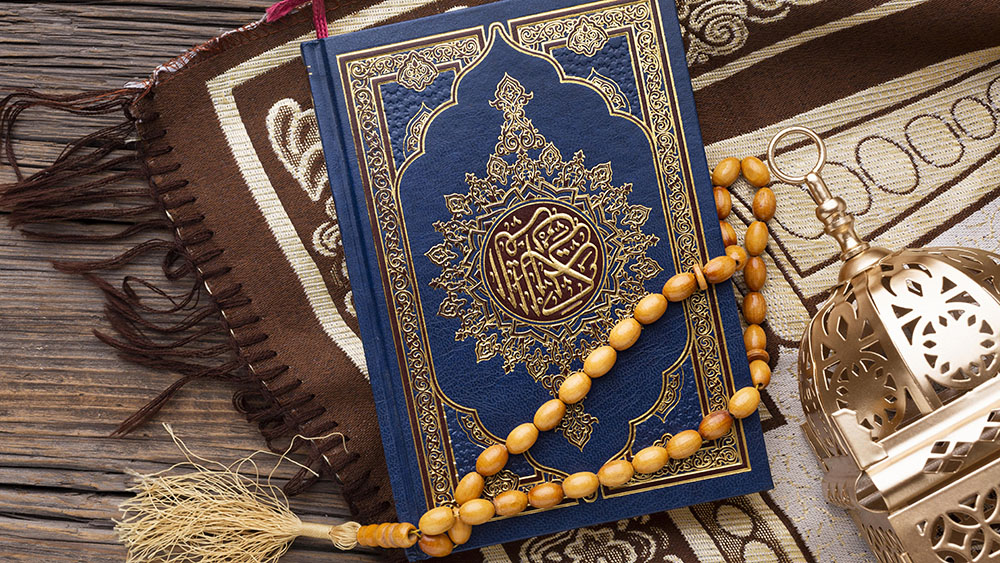
Most people don’t choose their religion; they inherit it. Whether one is raised Muslim, Catholic, Mormon, Jehovah’s Witness, or within any other tradition, belief normally forms long before anyone asks, “Is this true?” The deeper concern is, “Do I belong?” Family, culture, language, and community shape one’s faith so profoundly that questioning it can feel like betraying one’s own people. For many, the fear is real: rejection, shunning, damaged relationships, or [in some parts of the world] even death.
So if you hesitate at the thought of examining your beliefs, understand this clearly: fear doesn’t make you weak, it makes you human. The God who gave you a mind capable of inquiry never intended for truth to be avoided. Scripture shows again and again that those who seek truth often walk a costly road; Abraham leaving his homeland, Moses standing against Egypt, the prophets rejected by their own, the apostles misunderstood. Jesus Himself warned that truth may divide before it heals. Yet He also promised that those who seek will find, and that the truth sets people free, not enslaves them.

This article is not an attack on people. It is a testing of teachings. It is a distinction between the sincerity of believers and the truthfulness of the systems they’ve inherited. False gospels [whether in Islam, Mormonism, Catholicism, or Jehovah’s Witnesses] bind people not by malice, but by familiarity. Most have simply never been invited to examine the origins of what they were taught.
If the beliefs you hold are true, they will stand firm. If they are not, God is not honored by your clinging to them. Truth is not fragile. And God does not fear your questions.
Read what follows with courage. You are not walking away from your family or heritage by seeking truth; you are walking toward the God who knows you, loves you, and calls you to Himself.

For many Muslims, the Quran is the central miracle of Islam: perfect in language, unmatched in structure, and uncreated in nature. It is believed to have been revealed verbatim to Muhammad over a period of twenty-three years through the angel Gabriel. Yet when one examines the Quran itself [not through Hadith, not through classical tafsir, not through centuries of inherited tradition, but through the plain text of the Quran] an extraordinary dilemma emerges. It is a dilemma so foundational that it destabilizes the entire edifice of Islam from within. In its simplest form, the dilemma is this: if the Quran is true, Islam is false. And if the Bible is true, Islam is false. In either direction, Islam finds no ground on which to stand.
The Quran never affirms Islam’s basic historical claims about itself. Nowhere does the Quran state that it contains 114 chapters. Nowhere does it declare that the arrangement of surahs is divinely mandated. Nowhere does it say Muhammad received the entirety of its contents. Even the oft-cited first revelation [Surah 96 (Al-‘Alaq)] never names Muhammad.
The assertion that the Quran was revealed in its entirety to Muhammad over two decades does not come from the Quran; it comes from Hadith written generations after Muhammad’s death. This is not a minor issue. If the Quran is the clearest revelation of God to mankind, as Islamic theology insists, then its silence on the foundational details of its own origin raises serious questions about its self-authentication. No other major world religion asks its adherents to accept crucial doctrinal claims that the central scripture itself does not state.

Yet the deeper dilemma emerges not from what the Quran omits but from what it emphatically affirms. Across its pages, the Quran declares that the Torah (Tawrat), the Psalms (Zabur), and the Gospel (Injil) are revelations from God: authoritative, true, and binding. It does not accuse these Scriptures of corruption during Muhammad’s lifetime, nor does it warn believers to distrust the books possessed by Jews and Christians of the seventh century.
Instead, it commands them to judge by those books, to uphold them, and to verify truth claims through them. Surah 5:47 instructs, “Let the people of the Gospel judge by what God has revealed therein.” Surah 5:68 confronts the People of the Book with the charge that they “have no ground to stand upon unless [they] uphold the Torah and the Gospel.” Most striking of all, Surah 10:94 directs Muhammad himself: “If you are in doubt about what We have revealed to you, ask those who read the Scriptures before you.”
These passages are not marginal. They form a consistent and undeniable thread: the Quran affirms the authority of the Bible as it existed in the seventh century. And here the dilemma becomes unavoidable. If the Bible is corrupt, then the Quran is false, because the Quran repeatedly commands trust in the Bible. But if the Bible is true, then Islam is false, because the Bible’s testimony directly contradicts Muhammad’s claims. The Torah affirms Isaac, not Ishmael, as the covenant line.

The Prophets foretell a divine Messiah, not a merely human messenger. The Gospel presents Jesus as God incarnate, crucified for sin, risen from the dead, and exalted as Lord. These doctrines are not tangential; they are the very heart of the biblical revelation. They contradict the Quran’s teaching at the deepest possible level. Thus, the Muslim Dilemma stands unbroken: affirm the Bible and Islam collapses; deny the Bible and the Quran collapses.
The Quran tries to reinforce its authority through Surah 4:82, which argues that a true revelation from God contains no contradictions. Yet contradictions appear plainly within the Quranic text. One finds differing accounts of creation; conflicting descriptions of Noah’s family; divergent presentations of Mary’s lineage; inconsistencies regarding Pharaoh’s fate; and tension between absolute predestination and human responsibility. These contradictions have required Islamic scholars for centuries to employ elaborate and often strained harmonizations. This need for harmonization does not demonstrate the Quran’s clarity but its opacity.
Another tension arises in the Quran’s promise of perfect preservation. Surah 15:9 declares, “Indeed, it is We who sent down the Quran, and indeed, We will be its guardian.” Yet Islamic historical sources reveal the opposite: significant portions of the Quran were lost when many memorizers died at the Battle of Yamama; early codices differed in content and arrangement; companions such as Ibn Mas‘ud and Ubayy possessed non-Uthmanic readings; and the third caliph Uthman ordered all variant codices burned to enforce a standardized text. A perfect book should not require such extensive human intervention.

Against this backdrop, the Bible offers not merely a clearer revelation but a fundamentally different category of revelation. Scripture testifies that God’s ultimate self-disclosure is not a book but a Person. John 1 opens with majestic clarity: “In the beginning was the Word, and the Word was with God, and the Word was God.” The Word became flesh in Jesus Christ, God’s final and definitive revelation, as Hebrews 1:1–3 affirms.
Every theme in the Torah, every promise in the Prophets, every song in the Psalms converges in Him. There is no need for a prophet to override Him, no revelation to replace Him, no book to correct Him. Christianity rests on a coherent, historically grounded, theologically unified revelation that Islam cannot overturn without invalidating the Quran’s own testimony.
Thus, the question before every seeker [Muslim or otherwise] is not whether one is willing to challenge tradition but whether one is willing to follow truth wherever it leads. The Quran invites examination but collapses under the weight of its internal inconsistencies.

The Bible invites examination and reveals a unified story fulfilled in Christ. Jesus proclaims, without ambiguity or contradiction, “I am the way, the truth, and the life; no one comes to the Father except through Me” (John 14:6). These are not the words of a mere prophet; they are the self-attestation of the eternal Word made flesh.
If you seek truth, do not be afraid to test every claim. God does not fear honest inquiry. He designed the human mind to discern, to reason, and to pursue the light. Jesus does not offer a system; He offers Himself. And in Him you find what no book alone can give: peace with God, forgiveness of sin, and life everlasting. As He promised, “You will know the truth, and the truth will set you free” (John 8:32).